


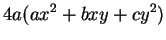
 be a quadratic form. Multiply by
  and complete
the square:
and complete
the square:
 |
 |
|
 |
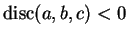 then
then
 , so
, so
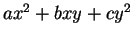 takes only positive or only negative values,
depending on the sign of
takes only positive or only negative values,
depending on the sign of  . In this sense, is very
definite about its choice of sign. If
. In this sense, is very
definite about its choice of sign. If
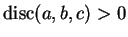 ,
then
,
then
 takes both positive and negative
values, so does also.
takes both positive and negative
values, so does also.
We will consider only definite forms in the next two lectures.